Anggarda Paramita

The Hidden Map Beneath Your Feet: The Ultimate Guide to Geoelectric Tests in Bali

Januari 11, 2026 | by Admin
Geoelectric Tests in Bali

The Hidden Map Beneath Your Feet: The Ultimate Guide to Geoelectric Tests in Bali

Geoelectric Tests in Bali

Planning to drill a water well in Bali? Don’t rely on guesswork. Discover how a Geoelectric Test in Bali works, why it is crucial for avoiding saltwater intrusion, and how it saves property owners millions in failed drilling costs.

1. Introduction: The Water Reality Behind the Tropical Paradise

Bali is synonymous with lush greenery, infinity pools, and thriving rice terraces. For an investor or a homeowner building a dream villa, water seems abundant. However, any seasoned contractor in Bali knows that the island faces a complex and growing water crisis. As tourism development accelerates, the demand on the local water table has reached critical levels.


For a property owner, the reliance on PDAM (government water supply) is often insufficient due to irregular flow or lack of infrastructure in developing areas. The solution? Drilling a deep well (Sumur Bor).
But here lies the gamble. You can hire a drilling rig, spend thousands of dollars, and drill 60 meters down, only to find nothing but dry rock—or worse, saline water that ruins your plumbing and kills your garden.


This is where the Geoelectric Test in Bali becomes the single most important step in your construction phase. It is not just a survey; it is an insurance policy against dry holes and wasted budgets. In this comprehensive guide, we will explore why looking before you drill is the smartest investment you can make on the Island of the Gods.

2. What is a Geoelectric Test? (The MRI for the Earth)

To understand why you need this service, you first need to understand what it is. In layman’s terms, a Geoelectric test (often called a Resistivity Survey) is like an MRI scan for the ground.

Just as a doctor doesn’t operate on a patient without seeing an X-ray or MRI first, a professional driller shouldn’t bore into the earth without seeing the geoelectric data.

The Science of Resistivity

The method relies on a fundamental principle of physics: different materials conduct electricity differently.

  • Hard Rock (Basalt/Limestone): High resistivity (electricity struggles to pass through).
  • Clay/Mud: Low resistivity.
  • Fresh Water Aquifers: Moderate resistivity (distinctive signature).
  • Salt Water: Very low resistivity (highly conductive).

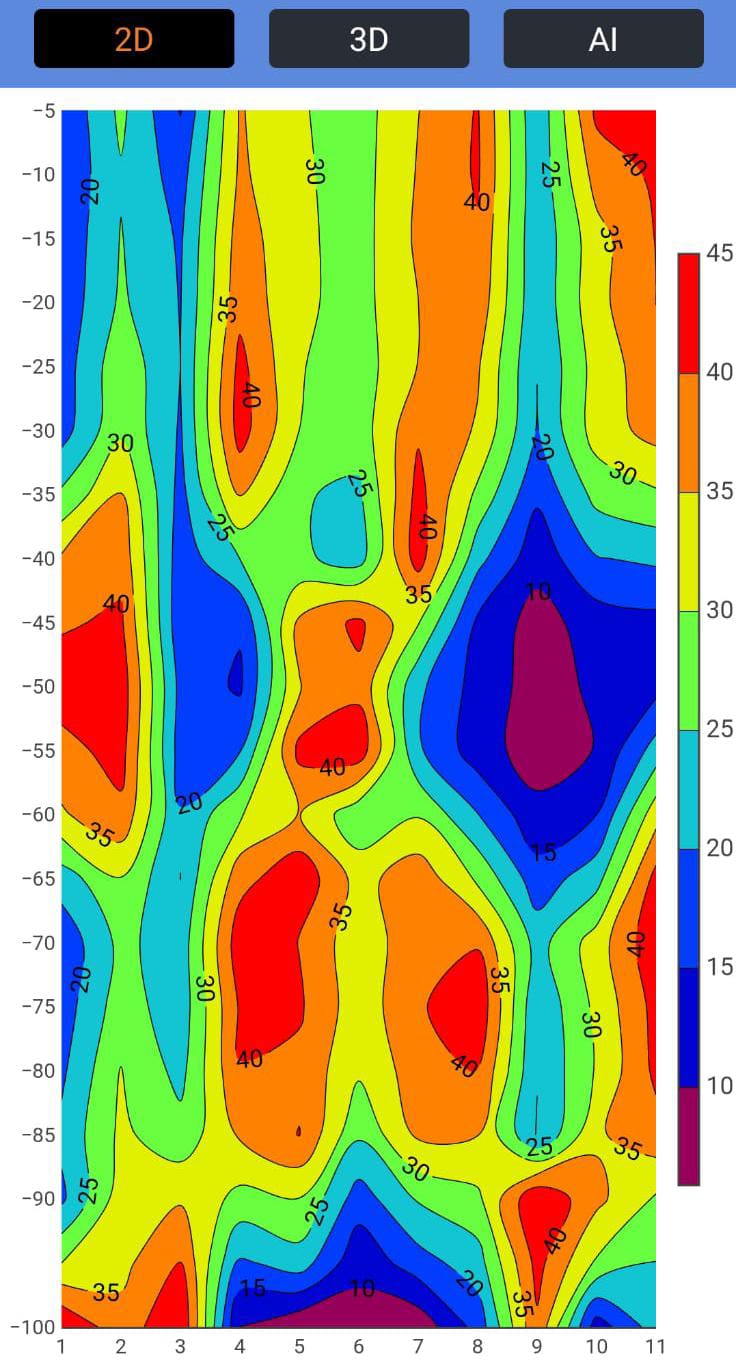
By injecting a controlled electrical current into the ground through electrodes and measuring the potential difference, geophysicists can map the sub-surface layers. They produce a cross-section image that reveals exactly where the rock is, where the clay lies, and most importantly, where the water aquifers are hiding and at what depth.

3. Why Bali’s Unique Geology Demands Scientific Surveys

If you were building in a massive, flat alluvial plain, you might get lucky by drilling anywhere. Bali is not that place. The island is geologically chaotic, a mix of ancient volcanoes, uplifted coral reefs, and sedimentary deposits.


Here is why a Geoelectric Test in Bali is location-dependent and critical:

The Limestone Challenges of The Bukit Peninsula (Uluwatu, Ungasan, Pecatu)

The Bukit area is essentially a giant block of uplifted limestone (Karst). Water here does not flow in uniform sheets; it flows in underground rivers through cracks and caves.

  • Without a test: You could drill 100 meters and hit solid rock, while five meters away, there is a massive underground stream.

With a test: The survey detects the fractures and cavities where water accumulates, allowing for pinpoint drilling precision.

The Volcanic Layers of Ubud and Kintamani

Central Bali is dominated by volcanic geology. The ground consists of layers of hard lava rock (andesite) sandwiched between softer layers of ash and parasitic cones.

  • The Risk: Aquifers are often trapped between hard rock layers. If your driller stops too early or misses the fracture zone, you get a low-debit well. Geoelectric data tells the driller exactly how deep to punch through the hard rock to reach the trapped water.

The Coastal Risks: Canggu, Seminyak, and Sanur

These are the most developed areas, sitting on sedimentary plains. While finding water is easier here, finding good water is the challenge.

  • The Threat: Saltwater intrusion. If you drill blindly near the coast, you risk tapping into a brackish layer. Once a well is contaminated with saltwater, it is virtually useless. Geoelectric surveys can distinguish between the freshwater layer and the saltwater interface.

4. How the Geoelectric Method Works: A Step-by-Step Guide

Clients often wonder what happens during a survey. It is a non-destructive process that typically takes one day of fieldwork.

Step 1: Site Assessment & Configuration

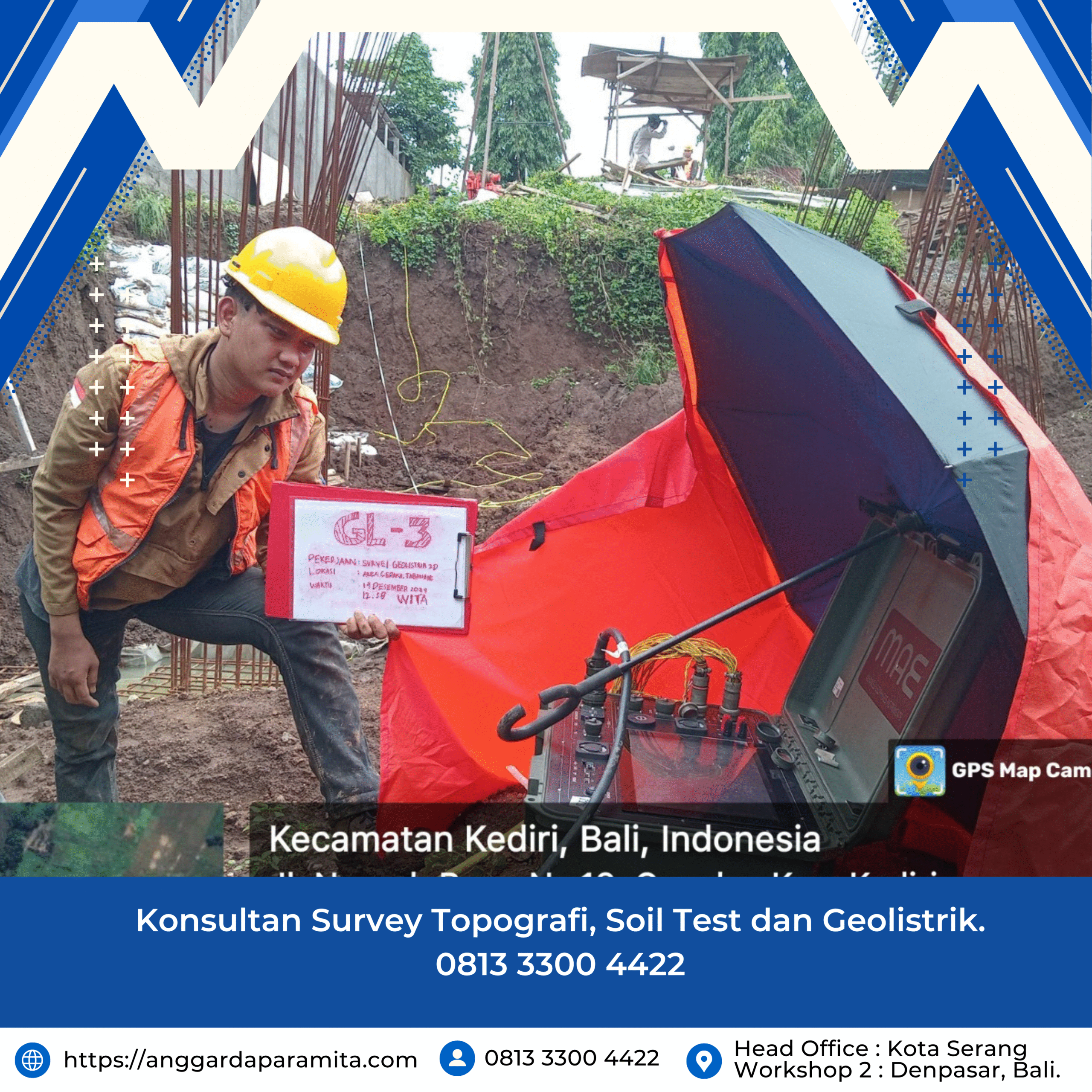
The team arrives at your location. Based on the land shape and size, they determine the configuration (usually the Schlumberger or Wenner configuration). They need a straight line to lay out cables—typically stretching 100 to 200 meters long to read depths of up to 100+ meters.

Step 2: Data Acquisition

  • Steel electrodes are hammered into the ground at specific intervals.
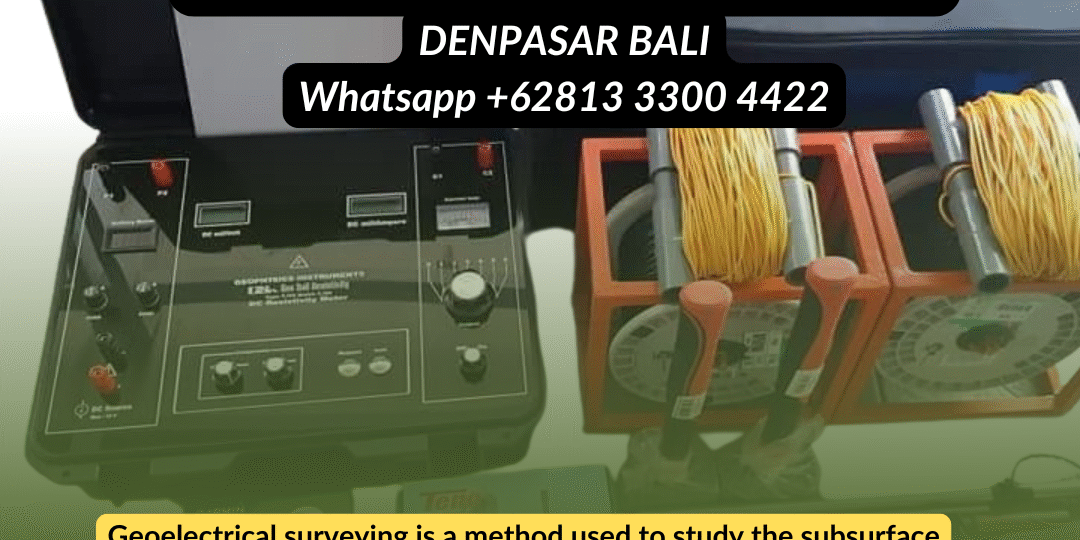
  • These are connected by cables to a central resistivity meter.
  • The operator sends a current into the ground and records the resistance values.
  • The electrodes are moved systematically to scan different depths.

Step 3: Computational Processing

The raw data is just a series of numbers. The real magic happens back in the office. Using specialized hydrogeological software (like Res2DInv), the data is inverted to create a 2D color-coded cross-section of the earth beneath your property.

Step 4: Interpretation and Reporting

A senior geologist analyzes the image. They look for the “blue zones” (often indicating water) amidst the “red/purple zones” (rock).
• The Output: You receive a report recommending the exact coordinate to drill and the estimated depth of the aquifer.

5. Geoelectricity vs. Traditional Dowsing: Science vs. Myth

In Bali, it is common to hear about “Balian” or traditional water dowsers who use coconut shells, sticks, or copper rods to find water.

While we respect local traditions, investing $50,000 in a villa construction based on a twitching stick is a high-risk financial strategy.

FeatureTraditional DowsingGeoelectric Survey
MethodIntuition / Pseudo-sciencePhysics & Geology
Depth PredictionGuessworkAccurate estimation (e.g., “Aquifer at 40-50m”)
Water QualityCannot determineCan predict salinity (Saltwater vs Fresh)
Rock HardnessUnknownIdentifies hard rock layers (crucial for drilling cost)
Data RecordNoneFull written report & 2D maps

For modern construction standards, banks, and engineers, only scientific data is acceptable.

6. The Critical Issue of Saltwater Intrusion

This deserves its own section because it is the number one enemy of property developers in Bali’s “hot spots” like Pererenan, Berawa, and Batu Bolong.


As hotels and beach clubs pump massive amounts of freshwater out of the ground, the hydrostatic pressure drops. This allows seawater from the ocean to seep inland, filling the void.


How Geoelectricity Helps: Freshwater has a resistivity of roughly 10–100 Ohm-meters. Seawater has a resistivity of less than 1 Ohm-meter. This massive difference makes saltwater intrusion “glow” on a geoelectric scan.


If a Geoelectric test in Bali reveals low resistivity at 40 meters but higher resistivity at 80 meters, the geologist might advise you to install a “casing” to block the top layer and only draw water from the deeper, protected aquifer. Without this data, a driller might mix the two layers, ruining your water supply permanently.

7. Cost Analysis: The Price of Testing vs. The Price of Guessing

Some budget-conscious owners ask: “Why should I pay for a test? Can’t we just drill?”

Let’s look at the numbers (estimates in IDR):

  • Scenario A (Blind Drilling):

    • Drilling Cost (60m): IDR 40,000,000

    • Pump & Installation: IDR 15,000,000

    • Result: Dry hole or Salty water.

    • Total Loss: IDR 55,000,000 (plus the cost of buying water trucks forever).

  • Scenario B (With Geoelectric Test):

    • Geoelectric Survey: IDR 3,000,000 – 5,000,000 (Approx).

    • Result: The report says “No Water on this land” OR “Water at 80m”.

    • Outcome: You either save IDR 55 million by not drilling, or you budget correctly for an 80m well that guarantees water.

The Return on Investment (ROI) is immediate. The cost of the test is a fraction of the cost of a failed well.

8. Beyond Water: Other Uses for Geoelectric Surveys in Construction

While finding water is the primary use in Bali, this technology is versatile. If you are building large structures, cliffs-edge villas, or basements, geoelectricity offers other insights:


Detecting Cavities (Sinkholes): Essential for limestone areas in Uluwatu. You do not want to build your swimming pool over a hidden underground cave that could collapse.


Landslide Risk Assessment: Identifying slip planes in steep terrain (like Ubud or Munduk).

Corrosivity Studies: Determining if the soil will corrode your building’s earthing systems or metal pipes.

9. FAQ: Common Questions About Finding Water in Bali

Q: Can a geoelectric test guarantee 100% that water will be found?

A: No method is 100%. Geology is complex. However, it increases the success rate from roughly 50% (guessing) to over 90-95%. It significantly reduces risk.

 A: Yes, but with limitations. Geoelectric tests require a cable spread. If the land is small, the team might need permission to extend cables into a neighbor’s land or a public road to get a deep reading.

RELATED POSTS

View all

view all